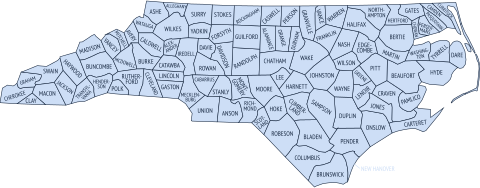
Durham County Court Records
Official Durham County court records are formal accounts of legal proceedings, documenting cases from the county’s trial courts as they are conducted and resolved. These documents are legally preserved and detail the case’s progress and outcome within the Durham County judicial system. They include dockets, pleadings, motions, affidavits, court minutes, exhibits, notices, and final judgments.
The Durham County Clerk of Superior Court is the official custodian of trial-level court records for both the local Superior and District Courts. These records, generated and updated throughout the various stages of litigation, are maintained in accordance with North Carolina’s Public Records Law and administrative policies of the state’s Judicial Branch.
Beyond case management, Durham County court records are valuable as educational and historical resources that clarify legal precedents and the functioning of the judicial system. These records also play an important role in promoting transparency and accountability by allowing public oversight of judicial actions. Although court records are a key element of public records, they differ from related materials such as vital records, arrest information, and federal case files, each of which is maintained by different agencies under unique access rules.
Are Durham County Court Records Public?
Yes. Durham County court records are generally considered public records under North Carolina’s Public Records Law. This law establishes a broad right of access to records created by government agencies, including the courts. Therefore, these records are typically accessible unless restricted by a specific court order or law. Records available usually include adult criminal cases, civil lawsuits, traffic cases, and most family law matters, and these are commonly accessed through the Clerk of Superior Court’s Office.
Nonetheless, public access to records is not absolute; it is often limited by the necessity of privacy and public safety, which can supersede the demand for disclosure. Consequently, confidential documents or those containing information that could jeopardize an individual’s or group’s safety are frequently either entirely restricted from public access or are released with redactions. The following is a list of typical records withheld from public disclosure:
- Records sealed by the court
- Expunged records
- Juvenile cases
- Confidential name changes
- Paternity proceedings
- Proceedings related to alcohol or drug treatment commitments
What Information is Available in Durham County Court Records?
Durham County court records document a case’s journey through the local legal system, offering comprehensive details. While content varies by case, common information found in these records includes
- Case Details: Filing date, case number, court division, and the type of case (e.g., criminal, civil, traffic, or probate).
- Parties Involved: Names of plaintiffs and defendants, along with any attorneys of record.
- Legal Claims: Descriptions of the criminal charges, civil claims, or other legal issues brought before the court.
- Court Filings: A collection of documents submitted by the parties, such as complaints, motions, petitions, affidavits, and responses.
- Procedural Information: Details regarding hearings, including scheduled court dates, motions that were heard, and other events.
- Case Financial Data: Information on assessed fines, court costs, restitution, or various fees mandated by the court.
- Final Rulings: Orders and judgments.
Durham County Court Records Search
To access court records in Durham County, North Carolina, a person has several options, depending on the case type and the level of detail required. The Clerk of Superior Court is the main custodian for trial-level court records. These records can be retrieved online, in person, by mail, or by phone.
Online Access
Durham County court records can be accessed remotely through the North Carolina Judicial Branch’s statewide case management system called eCourts, which allows searches by case number, party name, citation number, attorney information, or business name. Basic details accessible through the remote search tool include summaries, docket entries, and scheduled court dates. Nonetheless, the availability of these records varies by case type. Some documents, such as family law matters, juvenile cases, and sealed records, may be restricted or unavailable online.
Mail Access
To request Durham County court records via mail, an individual can contact the Clerk of Superior Court for guidance. Mail requests typically require the inclusion of sufficient identifying details (e.g., the case number, full name, and birth date), a self-addressed, stamped envelope, and the required fee, typically paid by money order or certified check made payable to the Clerk of Superior Court. The request should be mailed to the address provided below.
Clerk of Superior Court
510 South Dillard Street
Durham, NC 27701
Interested parties can also contact the Clerk’s Office by phone for general questions about record availability or request procedures.
In-Person Access
To access court records in Durham County, North Carolina, one may visit the county’s courthouse. The Clerk of Superior Court’s Office directly assists with these requests, and key services available in person include searching case information, locating and retrieving files, and requesting certified copies.
Fees for Court Records in Durham County
Accessing Durham County court records involves various fees, which are subject to the applicable North Carolina Statutes. The specific cost is determined by factors such as the type and format of the record, whether certification is needed, and the agency providing the record. Below are the resulting cost implications for accessing Durham County records:
- Plain Copies: $2 for the first copy/page; 25 cents for each additional page
- Certified Copies: $3
- Exemplified Copies: $10
Regarding vital records access and fees, one can contact the local Register of Deeds Office.
Durham County Courthouse Locations
Durham County operates both a Superior Court and a District Court, with each handling unique cases. The Superior Court has jurisdiction over a broad range of civil matters and severe criminal cases, while the District Court is responsible for most misdemeanors, infractions, and local ordinance violations. The county courthouse houses these two courts, and its physical address is listed below:
510 South Dillard Street
Durham, NC 27701
Phone: (919) 808-3000
Criminal Records Access in Durham County
For statewide criminal history checks, such as those required for employment, licensing, or general background screening, Durham County courts do not handle the process. Instead, these comprehensive checks, which compile criminal history data from various jurisdictions (including Durham), are managed at the state level. They are conducted by the North Carolina State Bureau of Investigation (SBI), an agency within the Department of Justice, and typically require fingerprint-based submissions. Access to these records is restricted to record owners and authorized entities.
However, members of the public can conduct a Durham County criminal records check through the courts by submitting a completed Criminal Record Search Form, which is provided by the North Carolina Judicial Branch. This form must be delivered in person or mailed to the Durham County Superior Court Clerk’s office. A fee of $25 is required for each search, as stipulated by G.S. 7A-308(a)(17). Acceptable payment methods include cash, credit card, check, or certified money order.
At the county level, Durham County courts provide access to local criminal case records, which reflect charges, filings, court proceedings, and case outcomes within the county. These records are typically sourced through the North Carolina Judicial Branch’s online case search systems, including the eCourts portal, or by visiting the Durham County Clerk of Superior Court’s Office in person. Details of criminal records typically available to the public include case summaries, docket entries, and disposition information, even though certain records, such as sealed cases or juvenile matters, may be restricted by law.
Durham County Probate Records
In Durham County, North Carolina, the Clerk of the Superior Court serves as the probate court judge, overseeing all probate matters. These proceedings involve the legal administration of estates and the court-supervised management of personal or financial affairs. The Clerk is responsible for ensuring the correct distribution of a deceased person’s estate, regardless of whether a valid will exists or the individual died intestate (without a will).
Probate cases, or estate cases, generally involve several types of court filings, such as wills, letters testamentary, and letters of administration. They also include filings related to guardianships and conservatorships, which are established when the court appoints an individual to manage the personal/financial affairs of a minor or an incapacitated adult. Additionally, trust-related documents may appear among estate records if court involvement is necessary.
Interested parties can access non-confidential Durham County probate records through self-service terminals available in the Clerk of Superior Court’s Office or, for recent cases, via the North Carolina Judicial Branch’s eCourts Portal. Even though basic case details are often accessible online, older records, document images, and certified copies usually require an in-person visit. Additionally, sensitive probate matters, such as cases involving minors or sealed proceedings, are typically restricted by law and are not accessible to the public.
Durham County Family Court Records
Durham County family court records refer to legal documents relating to family relationships and domestic responsibilities. These Durham family cases are heard within the District Court and include divorce, child support, spousal support, child custody and visitation, and adoption proceedings. Due to the sensitivity of Durham County family court records, access to these records is subject to specific legal restrictions.
Some family court records are searchable online through the North Carolina Judicial Branch’s eCourts portal, which provides basic case details, including case numbers, party names, filing dates, and upcoming court events. Nonetheless, not all family law cases are available online; cases such as adoptions, juvenile matters, and certain custody cases, which are confidential by law and not open to public access.
Family court records are also accessible in person at the Durham County Clerk of Superior Court’s Office, where public terminals allow on-site searches. It is worth noting that access to confidential family records requires a valid ID and proof of relationship with the subject of the record. Additionally, certified copies of family court records may be requested from the Clerk’s office, in person or by written request, and the associated fees apply.
Federal Court Records in Durham County
Federal court records for Durham County are maintained by the United States Court for the Middle District of North Carolina, which has jurisdiction over federal cases arising in the county. Federal courts have broad authority, encompassing a wide array of legal matters. Their jurisdiction includes cases involving federal laws, constitutional questions, disagreements between states, federal criminal cases, civil rights claims, bankruptcy proceedings, and civil lawsuits where the United States government is a party or the disputing parties are from different states.
Federal court records are available for review through several methods. One option is to visit the Clerk’s Office of the U.S. District Court in person, where public terminals are usually provided to search cases and review documents. Furthermore, the majority of federal case information and filings can be accessed online via the Public Access to Court Electronic Records (PACER service. PACER is a nationwide electronic system used to search federal court dockets and view case documents.